
How to Get Your Content Recommended by ChatGPT: SEO & AEO Strategies That Work
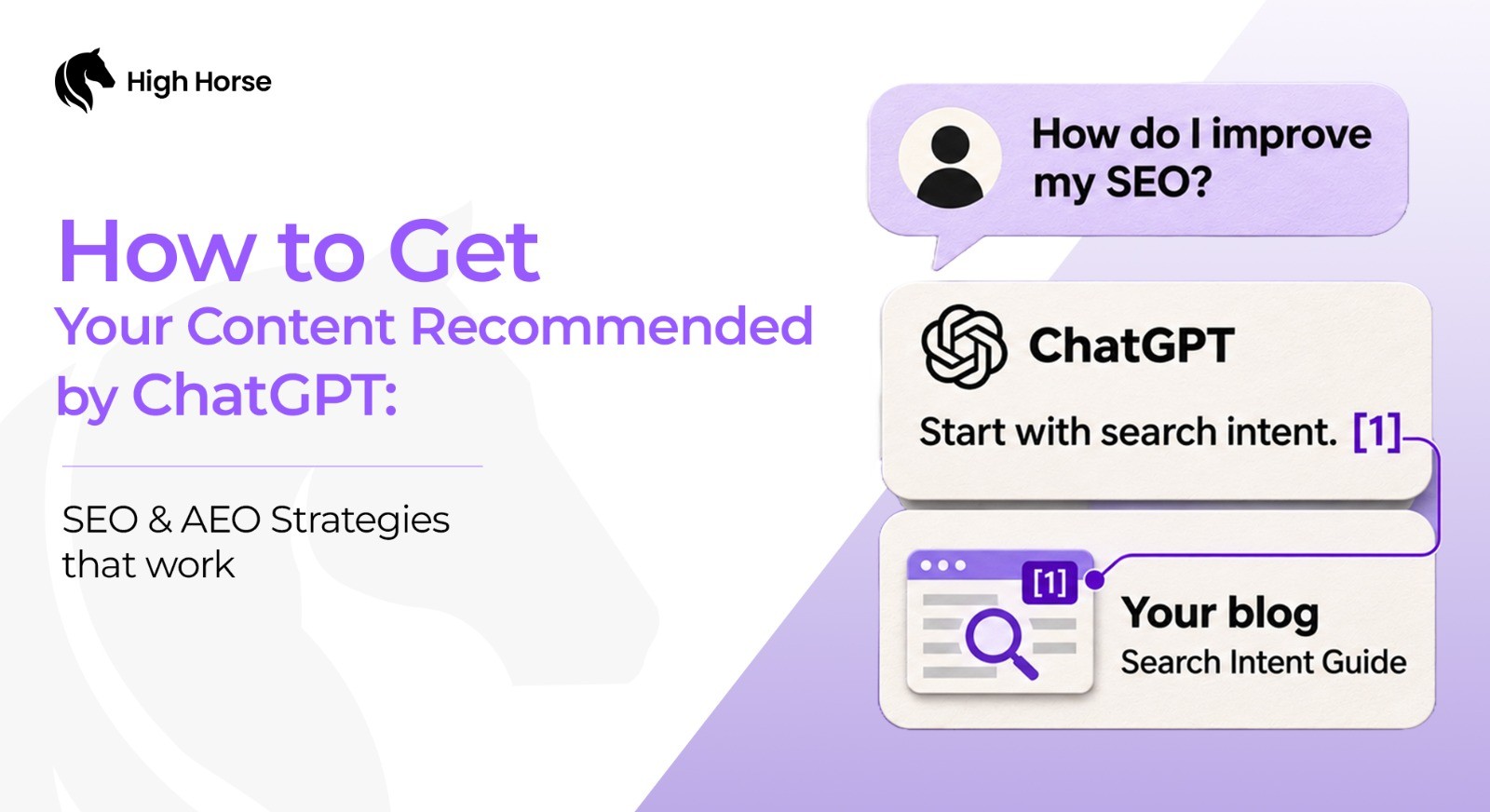
Introduction: Make Your Brand the Answer ChatGPT Recommends
The way people discover businesses, products and services is changing as AI-powered search tools become an important part of the customer journey. Instead of relying only on Google search results, users are increasingly asking ChatGPT for recommendations, comparisons and solutions to specific problems. This shift has made ChatGPT SEO, Answer Engine Optimization (AEO) and AI search optimization important parts of modern digital marketing. However, getting your content recommended by ChatGPT requires more than simply adding keywords to your website. Your content needs to provide accurate answers, demonstrate genuine expertise, build brand authority and remain accessible to AI search systems. By combining proven SEO strategies with effective AEO strategies, businesses can improve their chances of appearing in ChatGPT Search responses and being considered for relevant recommendations. In this guide, we explain how to optimize your website content for ChatGPT and build a stronger presence across AI search engines.
How to Make ChatGPT Notice, Understand and Recommend Your Website
Getting recommended by ChatGPT is not about finding a shortcut or manipulating an AI algorithm. It is about making your brand, expertise and content easy to discover, understand and trust. Here are the important steps to focus on:
1. Create Clear, Helpful and Answer-Focused Content
ChatGPT users often ask complete questions rather than searching with short keywords. Your content should address these questions directly and provide useful information without unnecessary introductions.
- Identify the common questions your target audience asks about your products, services and industry.
- Use clear question-based headings such as "How does SEO improve website visibility?" or "Which digital marketing strategy is suitable for small businesses?"
- Provide a direct answer immediately after each important heading.
- Explain complex topics using simple language, relevant examples and practical steps.
- Break lengthy information into short paragraphs, bullet points and numbered lists.
- Make sure every section provides meaningful information instead of repeating the same points.
Why it matters: Well-organised, answer-focused content is easier for readers to understand and can be easier for search systems to interpret and reference.
2. Build Strong Topical Authority Around Your Industry
Publishing multiple unrelated blogs does not automatically make your website an authority. You need to demonstrate consistent knowledge across the topics that matter to your audience.
- Select your main industry topics and identify relevant subtopics.
- Create detailed pillar pages covering important subjects.
- Publish supporting blogs that answer specific questions related to each pillar topic.
- Connect relevant articles through contextual internal links.
- Cover different search intents, including informational, commercial and transactional queries.
- Regularly update outdated information, statistics, examples and recommendations.
For example, a digital marketing agency can build topical authority around SEO, Google Ads, Meta Ads, content marketing and AI search optimization. Instead of publishing isolated articles, it should create connected content clusters that cover each subject in depth.
Why it matters: Consistent, relevant coverage helps establish what your website specialises in and gives search systems more context about your expertise.
3. Make Your Brand Information Consistent Across the Internet
ChatGPT may use information from different publicly available sources when answering questions and generating recommendations. If your brand information is incomplete or inconsistent, it can become harder for AI systems and potential customers to understand what your business actually offers.
- Clearly explain your business, services, target audience and areas of expertise on your website.
- Maintain consistent brand descriptions across your website, LinkedIn and business profiles.
- Keep your business name, contact information, service details and location accurate.
- Create dedicated service pages that explain what you offer and who can benefit from it.
- Publish detailed case studies, project examples and genuine customer experiences.
- Make sure your website and external profiles communicate the same core brand message.
Why it matters: A clear and consistent online identity helps build brand recognition and makes it easier for people and search systems to understand your business.
4. Earn Credible Brand Mentions and Build Online Authority
Your website is important, but your brand's presence should not be limited to your own domain. Relevant third-party mentions, reviews and industry contributions can provide additional context about your business.
- Publish expert articles on relevant industry websites.
- Participate in Reddit, Quora and other industry communities by answering genuine questions.
- Encourage satisfied customers to share honest and detailed reviews.
- Build a professional presence on LinkedIn through useful insights and industry discussions.
- Collaborate with relevant publications, partners and industry experts.
- Earn quality backlinks from websites that are relevant to your niche.
Avoid artificial brand mentions, spam comments and low-quality backlink schemes. Focus on earning genuine recognition from sources your audience already finds useful.
Why it matters: Independent references can strengthen your brand's credibility and help establish its relevance beyond your own website.
5. Make Your Website Easy for AI Search Systems to Access
Even the best content cannot be discovered through ChatGPT Search if important pages are inaccessible to its search crawler. Technical accessibility is therefore an important part of ChatGPT SEO.
- Check your website's robots.txt file and make sure you are not unintentionally blocking OAI-SearchBot.
- Review your website's firewall, CDN and security settings for crawler restrictions.
- Make important pages publicly accessible without mandatory login requirements.
- Fix broken links, incorrect redirects and unnecessary crawl errors.
- Use a clear website structure and descriptive page URLs.
- Keep your XML sitemap updated and submit it through relevant search engine tools.
- Ensure that important page content is accessible to crawlers rather than hidden behind inaccessible scripts or interactions.
OpenAI identifies OAI-SearchBot as the crawler used to discover content for ChatGPT Search. Allowing it to access your pages can help your content become eligible for discovery and citation, but it does not guarantee that ChatGPT will display or recommend it.
6. Use Structured Data to Give Search Engines Better Context
Structured data helps search engines understand the information available on your website. It can describe important details about your organisation, articles, products, services and other content.
- Implement Organization schema to describe your business.
- Use Article or BlogPosting schema for relevant blog content.
- Add Product schema to eligible product pages.
- Use LocalBusiness schema where appropriate for local businesses.
- Keep schema information accurate and consistent with visible page content.
- Validate your structured data using Google's Rich Results Test and Schema Markup Validator.
For example, Article schema can help describe the article's headline, author, publication date and publisher. Organization schema can provide structured information about your business.
Why it matters: Structured data provides additional context to search engines. However, schema markup alone does not guarantee ChatGPT recommendations or AI citations.
7. Publish Original Insights, Real Examples and Demonstrable Experience
AI-generated content and generic articles are easy to find across the internet. To stand out, your content should offer something more valuable than a summary of information already available elsewhere.
- Include original research, surveys, industry observations and relevant statistics.
- Share real project experiences and practical examples.
- Publish case studies that explain the challenge, strategy, execution and results.
- Add expert opinions and insights from people with relevant experience.
- Explain what worked, what did not work and what businesses can learn from it.
- Credit reliable sources when using external statistics, research or industry findings.
For example, instead of publishing another general article about Google Ads optimization, an agency can share a real campaign analysis explaining how changes to targeting, ad copy or landing pages affected campaign performance.
Why it matters: Original information and first-hand experience make your content more useful, distinctive and valuable to readers and other publishers.
7 Powerful SEO & AEO Strategies to Improve Your ChatGPT Visibility
Getting your website recommended by ChatGPT requires a combination of traditional Search Engine Optimization and modern Answer Engine Optimization. The following strategies can help you build a strong foundation for both.
Strategy 1: Target Conversational and Question-Based Keywords
Users often ask ChatGPT complete questions instead of searching with short keywords.
- Research questions using Google autocomplete, People Also Ask and forums.
- Identify relevant long-tail keywords and search intent.
- Include conversational phrases naturally in headings and content.
- Create dedicated sections for important user questions.
For example, target questions such as "How do I choose the right SEO agency?" instead of focusing only on "SEO agency".
Strategy 2: Follow an Answer-First Content Structure
Answer the user's question directly before providing additional details.
- Use clear, question-based headings.
- Start each section with a concise answer.
- Add supporting explanations, steps and examples.
- Include reliable facts and sources where relevant.
- Address related questions when useful.
This makes your content easier to scan and understand.
Strategy 3: Strengthen Traditional SEO Foundations
AI search optimization should complement, not replace, traditional SEO.
- Conduct keyword research and map keywords to relevant pages.
- Optimize title tags, meta descriptions and headings.
- Improve website speed and mobile usability.
- Fix indexing, crawling and technical SEO issues.
- Build relevant internal links and quality backlinks.
- Monitor organic performance through Google Search Console.
Strong SEO supports website discovery, but Google rankings do not guarantee ChatGPT recommendations.
Strategy 4: Create Comparison and Decision-Stage Content
Users often ask ChatGPT to compare products, services and businesses before making decisions.
- Create comparison articles such as "Option A vs Option B".
- Publish best-of and alternatives guides.
- Explain how to choose the right service provider.
- Cover pricing, features and selection criteria.
- Keep comparisons balanced and factually accurate.
This helps your content address users with stronger buying intent.
Strategy 5: Demonstrate Expertise and Build Trust
Make your content credible by showing genuine experience and supporting important claims.
- Add author names and relevant professional backgrounds.
- Include expert insights, original research and case studies.
- Link to reliable sources for important claims.
- Keep business and author information transparent.
- Update outdated facts and industry information.
Avoid fabricated credentials and unsupported performance claims.
Strategy 6: Improve AI Search Accessibility
Make sure relevant AI search crawlers can access and understand your website.
- Allow OAI-SearchBot to access important pages.
- Check robots.txt, firewall and CDN restrictions.
- Keep important content publicly accessible.
- Use descriptive headings and clear page structures.
- Implement relevant structured data.
- Fix broken links and technical errors.
Remember that OAI-SearchBot supports ChatGPT Search discovery, while GPTBot is associated with content collection for model training. Their permissions can be managed separately.
Strategy 7: Track AI Visibility and Referral Traffic
Measure whether your brand and website are appearing in relevant AI-generated responses.
- Check ChatGPT responses for relevant customer queries.
- Monitor citations and website references.
- Compare your visibility with competitors.
- Track ChatGPT referral traffic in Google Analytics 4.
- Measure leads and conversions from AI referrals.
- Identify which pages attract AI citations and visits.
Common AEO & SEO Mistakes That Can Keep Your Content Out of ChatGPT Recommendations
Even well-written content may struggle to gain visibility when its strategy focuses on shortcuts instead of usefulness, authority and accessibility.
Avoid these common mistakes:
- Keyword stuffing: Repeating keywords unnaturally can damage readability.
- Generic AI content: Publishing content without original insights or practical examples.
- Ignoring search intent: Focusing on keywords instead of answering user questions.
- Neglecting technical SEO: Blocking relevant crawlers or leaving pages inaccessible.
- Weak brand identity: Maintaining incomplete or inconsistent business information.
- Ignoring brand authority: Depending entirely on your own website for recognition.
- Misusing schema markup: Adding inaccurate or irrelevant structured data.
- Expecting instant results: Assuming a few optimized blogs will guarantee recommendations.
The goal should be to build a reliable digital presence that provides value to users and earns credibility across relevant platforms.
Why Choose High Horse to Build Your Brand's Visibility Across Google and ChatGPT?
Getting your brand discovered through Google and AI-powered search requires a connected strategy that combines content quality, technical SEO, brand authority and Answer Engine Optimization. At High Horse, we focus on building this foundation through data-driven SEO strategies, AEO-focused content optimization, technical improvements, keyword research and strategic content marketing. Our approach is designed to make your website easier to discover, your expertise easier to understand and your brand more relevant to the questions your potential customers are asking. From improving existing website content and building topical authority to strengthening technical accessibility and developing a consistent online presence, we help businesses prepare for the changing search landscape. Whether you need support from an experienced SEO agency or an AEO agency, High Horse can help you build a more comprehensive search visibility strategy across traditional and AI-powered search experiences.
From Search Rankings to AI Recommendations: Build Visibility That Lasts
The future of online discovery is not limited to traditional search engine results. As more users turn to ChatGPT and other AI search engines for information, comparisons and recommendations, businesses need to rethink how they create and optimize website content. Strong ChatGPT SEO starts with useful information, clear answers, genuine expertise and a technically accessible website. By combining traditional SEO with effective AEO strategies, businesses can improve their chances of being discovered, cited and considered in relevant AI-generated responses. Focus on building topical authority, earning credible brand mentions, publishing original insights and continuously monitoring your search performance. There is no guaranteed method to secure a ChatGPT recommendation, but a consistent approach to content optimization and online authority can strengthen your visibility over time. Start building content that does more than rank—make it genuinely useful enough to become a trusted answer.